
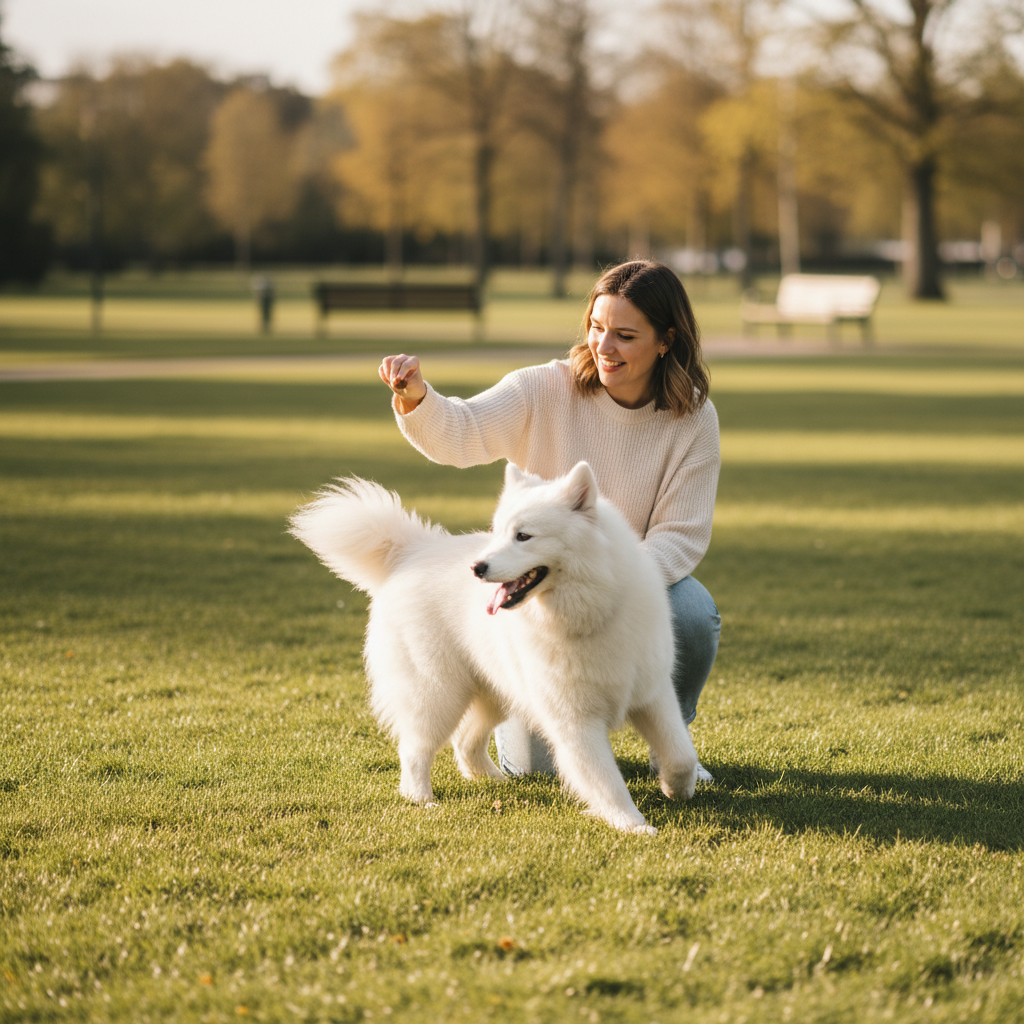
What You’ll Need
- High-value treats (small, soft, pea-sized pieces)
- A quiet training area with minimal distractions
- 5–10 minutes per session
- Patience and enthusiasm
Why Teaching Spin Matters
Spin is a fun, crowd-pleasing trick that provides mental stimulation, builds body awareness, and strengthens your bond with your dog. It’s one of the easier tricks to teach, making it perfect for beginners or as a warm-up for training sessions. Plus, it’s great for burning off a little energy indoors when the weather is bad.
The American Kennel Club includes spin in their trick dog titles, recognizing it as a behavior that demonstrates coordination and handler focus. For dogs who enjoy movement and engagement, spin is a joyful expression of training success. It can also be chained with other tricks (sit → spin → down) for impressive routines.
Step-by-Step: How to Teach Spin
Step 1: Lure the Circle
Start with your dog standing. Hold a treat at their nose and slowly lure them in a tight circle toward their tail. Lead them around clockwise (to your right) or counter-clockwise (to your left) — pick one direction to start. The moment they complete the circle, mark “Yes!” and reward.
Some dogs need smaller circles at first. If your dog loses interest or gets confused, try a half-circle, reward, then build up to the full spin.
Step 2: Add the Cue
Once your dog follows the lure smoothly in a complete circle, add the verbal cue “spin” just before you start the lure. Say “spin,” lure the circle, then mark and reward. Repeat until your dog associates the cue with the behavior. Then try saying “spin” and waiting a moment before luring — many dogs will start turning in anticipation.
Gradually fade the lure by making your hand motion smaller and smaller until your dog spins with just a verbal cue and a small circular hand signal.
Step 3: Teach the Other Direction
Once spin is reliable in one direction, teach the opposite using a different cue like “twist” or “turn.” Use the same luring technique in the opposite direction. Most dogs have a preferred direction, so the second direction may take longer to learn.
Practice spins in both directions, varying between them to keep your dog thinking and engaged.
Training Tips
- Keep sessions short: 5–10 minutes maximum
- Use enthusiastic praise: Spin is a fun trick — your energy matters
- Reward immediately: Mark the moment the spin completes
- Start with large circles: Tight spins come with practice
- Practice both directions: This improves body awareness
Common Mistakes to Avoid
- Moving the treat too fast: This confuses your dog
- Luring too far from the nose: Keep the treat close
- Skipping direction changes: Both directions improve coordination
- Getting dizzy together: Take breaks if your dog seems disoriented
Troubleshooting
My dog follows the treat but doesn’t complete the circle: Go halfway, reward, then continue. Build up gradually.
My dog sits instead of standing: Practice spin from a stand. If your dog keeps sitting, reward standing first, then work on spin.
My dog only spins one direction: This is normal. Keep practicing both, but don’t worry if one direction stays stronger.
When to Move On
Your dog has mastered spin when they perform smooth, complete circles in both directions on verbal cue alone. You can then chain spin with other tricks, add distance (spin from across the room), or teach variations like “weave” through your legs.